
Persona Turns 30: How Atlus Built One of Gaming’s Most Influential RPG Franchises

Persona Turns 30: Why Atlus’ RPG Series Became One of Gaming’s Most Influential Franchises
For many players, Persona is more than a role-playing game series. It is a coming-of-age story, a psychological journey, a social simulator, and a reflection on the struggles of modern life. Over the last three decades, Atlus has transformed what began as a niche spin-off of Shin Megami Tensei into one of the most influential RPG franchises in gaming history.
As Persona celebrates its 30th anniversary, its impact can be seen everywhere—from the design of modern RPGs and indie games to the growing popularity of character-driven storytelling. What started as a cult favorite in Japan has become a global phenomenon that continues to shape the future of the genre.
The Origins of Persona

The franchise began in 1996 with Revelations: Persona on the original PlayStation. Developed by Atlus, the game was inspired by the concept of Jungian psychology, particularly the idea of the “persona” as the mask people present to the world.
Unlike traditional fantasy RPGs that focused on warriors and dragons, Persona placed players in contemporary urban settings where high school students confronted supernatural threats. These characters wielded Personas—manifestations of their inner selves—to battle demons and uncover hidden truths.
The early games, including Persona 2: Innocent Sin and Persona 2: Eternal Punishment, explored themes such as identity, rumor, trauma, and societal pressure. While critically respected, they remained relatively niche outside Japan.
Few could have predicted that the series would eventually become one of gaming’s defining franchises.
The Revolution of Persona 3
Everything changed in 2006.
Persona 3 introduced mechanics that would become the foundation of the modern series. Instead of focusing solely on dungeon exploration and combat, the game asked a different question:
What if your everyday life was just as important as your battles?
Players attended school, joined clubs, formed friendships, studied for exams, and balanced social obligations while fighting supernatural enemies during the mysterious “Dark Hour.”
This fusion of life simulation and RPG systems was revolutionary. Time became a resource. Every decision mattered. Spending an afternoon with a friend could be just as valuable as defeating a powerful monster.
The result was a game that made players emotionally invest in its characters in ways few RPGs had accomplished before.
Today, many of the social and relationship mechanics that appear throughout modern RPGs can trace part of their DNA back to Persona 3.
Persona 4 and the Power of Character-Driven Storytelling
If Persona 3 established the formula, Persona 4 perfected its emotional core.
Released in 2008, the game transported players to the rural town of Inaba, where a mysterious murder case unfolded alongside a supernatural television world.
What made Persona 4 memorable wasn’t just the mystery—it was the cast.
The Investigation Team felt less like RPG party members and more like genuine friends. Players spent dozens of hours learning about their insecurities, ambitions, fears, and personal struggles.
The game’s themes of self-acceptance and confronting hidden aspects of identity resonated with audiences worldwide. Its character writing became a benchmark for storytelling in the genre.
Many fans still consider Persona 4 Golden one of the greatest RPGs ever created, not because of its combat system, but because of how deeply it connected players to its world.
Persona 5 Becomes a Global Phenomenon
Then came Persona 5.
Released in 2016 in Japan and 2017 internationally, the game propelled the franchise into mainstream gaming culture.
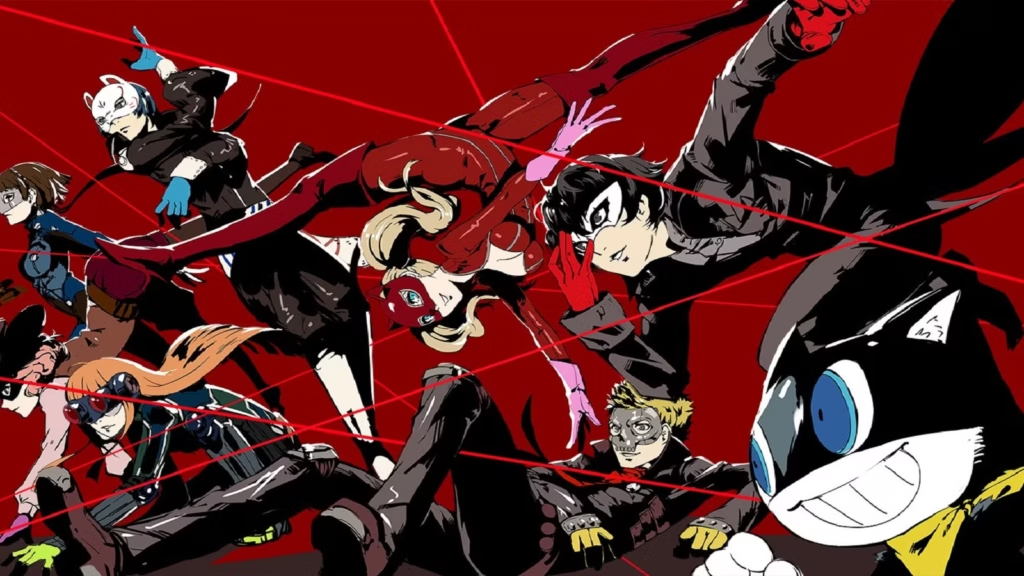
With its striking red-and-black visual identity, stylish menus, jazz-inspired soundtrack, and themes of rebellion against corruption, Persona 5 felt unlike anything else on the market.
The Phantom Thieves quickly became iconic gaming characters. Their mission to challenge abusive authority figures resonated with players around the world, while the game’s polished presentation elevated every aspect of the experience.
More importantly, Persona 5 demonstrated that a deeply Japanese RPG could achieve global success without sacrificing its cultural identity.
The game sold millions of copies, introduced countless newcomers to the franchise, and helped establish Atlus as one of the industry’s most respected RPG developers.
For many younger players, Persona 5 was their first encounter with Japanese role-playing games beyond major franchises like Final Fantasy and Pokémon.
Why Persona Matters Beyond RPGs
The influence of Persona extends far beyond its own genre.
Its social-link system inspired relationship mechanics in countless RPGs. Developers increasingly recognized that players wanted meaningful interactions, not just combat progression.
Its calendar-based structure demonstrated that time management could create tension and player agency without relying on traditional difficulty systems.
Its focus on psychological themes proved that video games could explore complex ideas about identity, mental health, and personal growth while remaining entertaining.
Even games that look nothing like Persona often borrow elements from its design philosophy: strong ensemble casts, relationship-building mechanics, and the blending of everyday life with larger narrative stakes.
The franchise helped redefine what players expect from character-driven RPGs.

The Art of Style
One of Persona’s greatest achievements is its commitment to artistic identity.
Every major entry has a distinct visual language. Menus are not merely interfaces; they are extensions of the game’s themes and personality.
From the blue melancholy of Persona 3 to the bright yellow optimism of Persona 4 and the rebellious red aesthetic of Persona 5, Atlus treats design as storytelling.
This approach has influenced countless developers and designers. Today, discussions about video game UI frequently reference Persona as an example of how interface design can enhance narrative immersion.
For art directors and visual storytellers, the series remains a masterclass in cohesive branding and world-building.
Music That Defines Generations
Few gaming franchises are as closely associated with their soundtracks as Persona.
Composers such as Shoji Meguro helped create a musical identity that blends rock, jazz, electronic music, pop, and experimental sounds into something uniquely recognizable.
Tracks like “Mass Destruction,” “Reach Out to the Truth,” and “Last Surprise” have become cultural touchstones among RPG fans.
The music doesn’t simply accompany gameplay—it reinforces mood, character, and theme.
Thirty years later, Persona concerts continue to sell out venues, demonstrating how deeply the series’ soundtracks resonate with audiences.
The Future of Persona
As Atlus looks beyond the franchise’s 30th anniversary, anticipation continues to grow.
The success of Persona 3 Reload demonstrated that interest in the series remains stronger than ever, while fans eagerly await news about the next major entry.
The gaming landscape has changed dramatically since 1996, but the core appeal of Persona remains timeless:
People searching for connection.
Young adults trying to understand themselves.
Friendships that shape our lives.
The masks we wear and the truths we hide.
Those themes remain just as relevant today as they were three decades ago.
Final Thoughts
Few franchises have evolved as successfully as Persona.
What began as an experimental RPG inspired by psychology has become one of gaming’s most influential storytelling platforms. Its blend of social simulation, character development, stylish presentation, and emotional depth continues to inspire developers around the world.
Thirty years later, Persona is no longer a niche spin-off.
It is a cultural landmark.
And if the series’ history has shown anything, it’s that Atlus still has plenty of stories left to tell behind the mask.
Discover more from Rotten Usagi
Subscribe to get the latest posts sent to your email.


